Tag Archives: group projects

The “In Case I Get Hit by a Truck” Assignment

I originally planned on following up on my group projects assignment within a week, but got distracted by semantics. I’ll probably put that in another piece some day.

Like many people, I conflate the terms “group work” and “group projects” in discussions. But they are totally different activities.

“Group work” in the educational world refers to a pedagogic strategy in which small groups (3-4 kids) are given the same task to complete. The tasks themselves are often designed to be open-ended. It’s part of the “collaborative learning” theory, explicitly designed for heterogeneous (untracked) classrooms. (I wrote about group work and collaborative learning a while back.) When people gripe about “expecting the smart kids to teach everyone else” in the context of group work, they are usually wrong. Teachers using collaborative learning often rebuke the kids who come up with “the answer” as opposed to allowing “everyone to contribute”.

“Group projects” have occasioned whining for decades longer than group work. But they can be a legitimate academic device to help students acquire certain skills. For example, students need presentation experience, but thirty individual presentations is torture to experience, never mind grade. Other times there just aren’t thirty topics to assign in depth. “Explore key events leading up to the Civil War” or “key playwrights in the Elizabethan era”. So for many reasons, group projects are educationally appropriate in certain cases. (Never in math, though. Unless you’re teaching a homogenous class of overachievers and have some spare time. hahahahaha.)

And yeah, group projects also prepare you for real life. Sure, one person might do the work while others get the credit. But slacker team members aren’t the only obstacle. Obsessive naggers, passive-aggressives, domineering fascists….all part of the interpersonal experience. Is it any wonder I spent life as a self-employed specialist and then went into teaching? Independent contributor, am I.

So how does a teacher assign meaningful group projects while maximizing the possibility of productive activity and minimize the impact of freeloaders, bossybritches, and control freaks?

My advice is to start by carefully considering group assignments.

  1. Most of the time, form groups by ability. This is important. It allows me to monitor the low achieving groups either to help them as they genuinely work or kick their asses if they slack off.
  2. Every so often, allow the kids to form their own groups BUT be up front that there will be no orphans. If there are kids who don’t have friends in the class, I generally put those kids together and then monitor them closely. Sometimes, I’ll have to add kids to an existing group and it helps to have made it clear up front that there will be no whining or exclusions.
  3. Also every so often, on carefully selected short-term projects, I do random group formation. Sometimes I use birthdays. But if I want to be sure the random groups are age or gender based, I feed the list to Grok or Claud and then review it (they often skip names or put someone twice in a group).

I always include a lecture up front. I expect to be informed of unhappiness. Ideally, ahead of time. If someone in on the phone constantly, I should notice and make that person unhappy. But if I don’t, tell me so I can proceed with the unhappiness. Hurt feelings, no one is listening to you? Tell me. . I may tell you to speak up more and stop sulking. I might also decide that you’ve got a steamroller who isn’t listening to anyone. Unhappy with your inferior teammates, having to do all their work again? Tell me. I’m going to order you to stop redoing everyone’s work and stop being such a damn control freak. I may also tell your teammates to step up and work harder.

And so on.

Most important of all: I always include a (forgive the ed word) reflection as part of the assignment. So the students turn in the group work as a collective effort, but each individual has to write a reflection. I grade the reflection as part of the project but it could be done independently as well. The reflection includes analysis of how the team worked together.

This not only gives me insight into any problems the team had, but also gives me a good idea of the relative participation of each member. It also allows me to modulate the grade so that slackers in particular get a lower grade. In fact, slackers often don’t turn in a reflection, which automatically drops their grade to a C.

A variation on this I’ve used when I’m suspicious that a lot of kids aren’t working is the “In Case I Get Hit By A Truck” assignment. I will suddenly announce in the middle of class to drop everything, pull out a piece of paper, and write down what has happened in the group thus far. Include diagrams, decisions, some flowcharts if needed. No talking. No consults. Just get it on paper.

Why? Because in the real world, your co-worker may suddenly disappear and your boss will expect you to take over. It’s….not fun. Don’t be that guy. And then, of course, I tell them that I never documented anything, so do what I say, not what I do.

Pedagogically speaking, an assignment like this early in the class will do much to discourage slackers. It’s also very useful to learn who needs to be watched carefully. Plus, they won’t get an A when someone else did all the work. Grade grubbers everywhere can rest easy, you obsessive competitive freaks. Kidding. Kind of.

Hey, under a thousand.

Freeloaders, Bossybritches, and Control Freaks

Back in the day when I taught “book club”, one of my students (they were all Asian, this one was Chinese American) wrote this really fantastic narrative about a team project he had that I’ve vividly remembered for close to 20 years. Patrick (his “American name”) was, to his horror, paired with Kevin, one of the two white kids in his class at his 90% Asian middle school class. He didn’t work very hard. He didn’t care that he got Bs because even though he was smart, he never did his homework and his parents didn’t seem to mind. Patrick included descriptive details and exchanges in his story, and Kevin’s every sentence started with “Dude”.

Kevin and Patrick were assigned a presentation on predators. Patrick studiously took notes on their resources as their teacher had recommended because (and he included this over and over) he always obeyed the teacher. Kevin joked with his friends, but then scribbled down some thoughts on predators. Patrick went to the teacher and observed that Kevin’s work was not neat, should he redo it? Absolutely not, the teacher said. Patrick went home and redid all Kevin’s work. Kevin noticed the next day and said “Dude, what’s up? I liked mine better” and redoes it, adding more details and scribbled pictures. Rinse and repeat for three days as Patrick frantically looks up every bit of information he can regurgitate about predators and Kevin horses around throwing spit wads but getting some work done that Patrick deems unacceptable and redoes. He complains to the teacher that Kevin isn’t following her rules, teacher sternly tells him to accept Kevin’s work, Patrick goes home and spends hours redoing it, Kevin notices (“Dude!”) and cheerfully redoes it again, with more messiness and more pictures. Patrick is coming unglued. They are making their Power Points and Kevin’s all “Dude, this picture’s great! Look, the shark is ripping the fish in half!” while Patrick deletes the image for, I don’t remember, but probably the food chain or something.

Comes the time to present. Patrick doesn’t want Kevin to present at all and Kevin doesn’t object—”Sure, dude, if you want to, but you gotta include the story about the falcon”—but the teacher says that they both have to speak. Patrick frontloads the presentation as much as possible, leaving as little as possible for Kevin. Teacher calls “time”, but he plows on to include more facts, so they won’t be downgraded for Kevin’s failing. But finally, he has to yield to Kevin.

And Kevin killed it. The beauty of Patrick’s narrative, which as I said has stayed with me for years, is that he understood that Kevin’s presentation was far superior to his own dry recitation. Kevin included facts—facts he’d scribbled down, but also some of Patrick’s research which he’d clearly read. He edited his commentary to leave out the parts of his assigned topic that Patrick had bogarted into his own talk and instead illustrated Patrick’s facts with illustrations. He gave examples of the difference in behaviors between preys and predators. He told all the cool stories. The class was enthralled.

They got three grades: one each for their presentations, and then a team grade on the report. Kevin got an A. Patrick got a B. Their report, which Patrick had completely rewritten, also got a B. Kevin is ecstatic. “Dude, a B! That’s the highest grade I ever got on one of these reports. But I think you should have kept the pictures in!”

I laughed my ass off and called Patrick up. “That’s such a great story. With a happy ending, even! I hope you learned a lot.”

Patrick was too polite to be upset, but he was clearly shocked. “You think it’s good that Kevin got a higher grade?”

“I do. For one thing, you consistently ignored the teacher. Which is kind of weird, isn’t it? You mention how important it was to listen to the teacher and then….didn’t. Maybe that’s why you got a lower grade?”

“I always listen to the teacher!”

“No. You nod when the teacher tells you to do something, and then do exactly the opposite. In your story, you talk about all the times you asked the teacher if you could redo Kevin’s work. Does the teacher ever say sure, redo it?”

Patrick sat back, astonished. “I never thought of that. You mean….being polite to a teacher isn’t the same thing as obeying the teacher.”

“You’ve now just described my childhood. I obeyed, but always told everyone the rules were bullshit. You’re probably better off sneaking around.”

“But do you think Kevin deserved the higher grade?”

“Well, I don’t have the work itself to judge but your narrative is excellent and honest. Don’t you think he did a better job on the oral presentation?”

“But I did all the work.”

“If you did all the work, there wouldn’t have been any of his work to redo every night. No, Kevin was learning and doing and goofing around and making you very unhappy. But by your own telling he read your research, did his own research, and integrated it all into a presentation that the class loved. Meanwhile, you can’t blame him for the report because it was all your work. You explicitly rejected his contributions.”

Patrick mulled this. “I’ve seen this since then, too. Like, there’s something about not working too hard.”

I laughed. “Yes, particularly in presentations. You have to find the sweet spot between on the one extreme actually not working at all and just winging it and on the other showing how hard you worked to the point of being tedious about it.”

“So…be more natural? That’s why he did better despite doing no work?”

“Kevin was definitely more natural, in your telling. But your telling also made it clear that Kevin was working. He was smart. He used facts. That’s where your cultural and personal biases come into play. You are being—forgive me—racist.”

Patrick was shocked. “Kevin’s white. How can I be racist?”

I snorfled. “Come on. Your whole story reveals your unhappiness with this white loser. White kids can’t be smart. They don’t work hard. They don’t care. They goof around too much. Now, I agree that these are more cultural than racial biases and also—as you observe—it’s practically impossible to get condemned for prejudice against whites. But it was all over your story. Again, that’s what makes your story so fantastic. Your narrative includes details that increase the complexity and makes the reader side with Kevin. ”

“Well, not all readers,” Patrick grinned. “That’s just you being white. Chinese kids would hate Kevin.”

“hahahaha!”

*************************************************

This was before my smartphone, or I’d have taken a picture of Patrick’s story. I have work from students going back to 2009. But my memory is very clear on the key plot points.

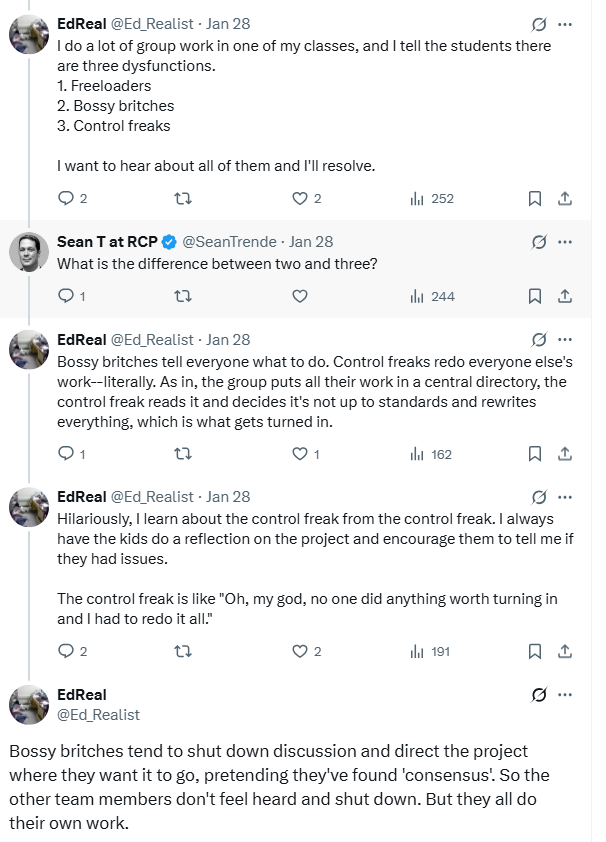
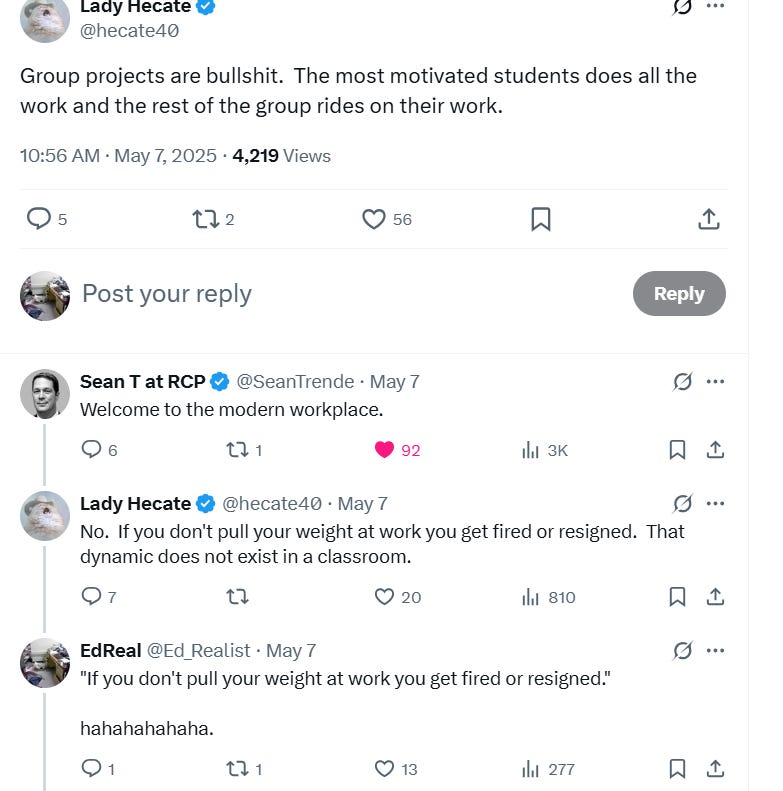
The rise of AI has given rise to a multitude of think pieces and tweets from professors who are shocked at the near-universal invasion of cheating on every aspect of college work. Sean Trende has observed several times that a fix for this is oral presentations and group work, as well as in-person tests. This gave rise to the universal complaint about group work and this typical exchange:

A lifetime of listening to swotters and dogooders whine about group work has left me unmoved by their bleats. Boohoo. You didn’t get a lower grade, someone else got a higher grade.

OK, I’m kind of kidding. But only kind of. In all my years of education, I only have two clear memories of group projects. Both were in my first stint of grad school, and both were given top honors. In one case, the professor borrowed our slides and continued to use them in his class until he retired. And in both cases, there was a slacker or two in the group. Didn’t bother me at all.

Do not confuse this as an apologia for group assignments. I oppose any kind of group projects in high school math, which are almost entirely A Very Bad Thing. Giving math students a group task, sure. Not with all those bullshit roles , though. And grouping by ability is essential. But never group projects. There’s no time in math for group projects anyway.

In other subjects, at all levels of education, group projects are reasonable and normal and collaboration is an essential skill in the real world. For teachers, group projects presents assessment challenges. The three primary interpersonal difficulties in group work are:

Freeloaders

Bossybritches

Control freaks

I do not deny the existence of freeloaders. They exist and I have ways of identifying them. But let’s give equal time. Control freaks and bossy britches (aka domineering assholes) represent personality types that can be death to co-operative work. Honestly, I don’t think I can improve upon my explanation to Sean Trende:

There’s not just one group dysfunction. There are several. It’s just that you rarely hear anyone complain about the problem of bossybritches and control freaks in the context of school group projects. Possibly—I mean, I’m just speculating—because all the people bitching about freeloaders often might just be, like Patrick, control freaks who don’t recognize participation because it doesn’t mean their exacting (and sometimes inferior) standards.

The trick for teachers lies in finding the dysfunctional ones and making their lives unhappy until they learn to change, rather than do away with group projects entirely.


Design a site like this with WordPress.com
Get started